 info@euprera.org
 Facebook
 YouTube
 LinkedIn

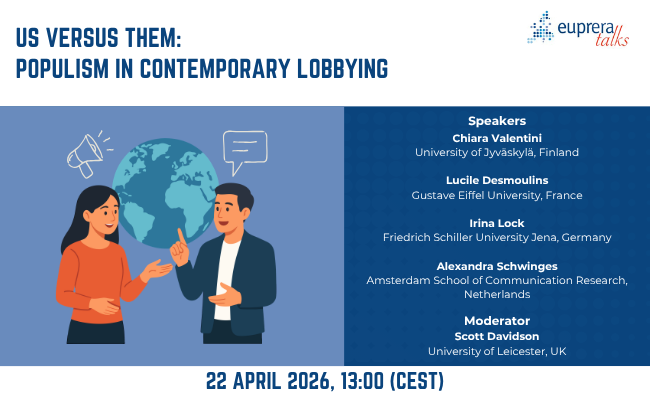
#EUPRERAtalks – Us Versus Them: Populism in Contemporary Lobbying
Us Versus Them: Populism in Contemporary Lobbying
Date and Time: April 22, 2026, 13:00 (CEST)
What to expect from the webinar
Lobbying relies heavily on the linguistic framing of policy issues. Recently, large organisations, such as Big Tech like Airbnb or the French food industry, have adopted populist strategies, positioning themselves as champions of “the people” against regulatory “elites.” This communication style frames social issues as moral struggles, often mobilising grassroots grievances to influence policy.
Given the rise of populist politics across Europe, understanding how such populist appeals operate within lobbying strategies – and their consequences – represents a new challenge for strategic communication scholars. This panel examines the ethical and democratic implications of populist lobbying, guided by these questions:
- How do we understand and conceptualise populist lobbying, and in what ways might it contravene the hopes or expectations of normative strategic communication theories? Do we accept the trend exists, and if so, how should it be viewed if adopting varying theoretical starting points?
- To what extent are organisations deploying populist rhetoric in their lobbying? What is its characteristics when deployed in a lobbying context?
- What are the defining elements of populist lobbying for future research?
The webinar highlights a growing concern that the use of populist strategies by “Big Tech” or “Big Food” may undermine democratic norms and erode public trust.
The webinar will blend short paper presentations plus questions and open discussion.
The three short papers are:
- Scott Davidson and Chiara Valentini on the task of developing a conceptual framework for understanding populism within public affairs practice, by distinguishing between its ideological, strategic, and rhetorical dimensions.
- Lucile Desmoulins presents an investigation on populist tendencies within French livestock trade organisations, where lobbying taps into cultural divides over food, the countryside, and national identity.
- Alexandra Schwinges and Irina Lock analyse lobbying in Amsterdam to reveal how Airbnb positions itself as an ally to “ordinary homeowners” against restrictive city regulations, highlighting how Big Tech battles local governments.
The webinar is organised by the Public Affairs and Lobbying network within EUPRERA.

Speakers
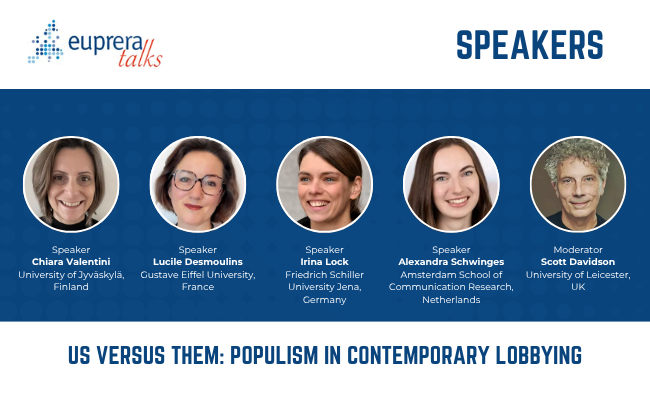
Scott Davidson, Lecturer, University of Leicester, UK
Scott Davidson is a lecturer in Media and Public Relations at the University of Leicester. He is the Director of the EUPRERA Network on Public Affairs and Lobbying and Earth-Space Sustainability lead at the Leverhulme Centre for Humanity and Space.
Chiara Valentini, Professor, University of Jyväskylä, Finland
Chiara Valentini is Professor and Head of Corporate Communication Discipline, at Jyväskylä University School of Business and Economics (JSBE). Her work has appeared in several international peer-reviewed journals and has authored and co-authored over a hundred of scholarly works in strategic public relations, government communication, and conflict and crisis communication in the digital environment.
Lucile Desmoulins, Associate Professor, Gustave Eiffel University, France
Lucile Desmoulins is an Associate Professor of Information and Communication Sciences at Gustave Eiffel University. She manages a Master’s programme in Business Intelligence, Influence, Lobbying, Advocacy and Public Relations Strategies. Her research focuses on the interplay between organisational and strategic communications, particularly digital public relations strategies, dark influence methods, and hybrid political organisations, such as ‘think tanks’.
Irina Lock, Professor, Institute of Communication Science, Friedrich Schiller University Jena, Germany
Irina Lock is Professor of Strategic Communication at the Institute of Communication Science, Friedrich Schiller University Jena. She studies lobbying empirically from a strategic communication perspective and is a founding member of the EUPRERA Public Affairs and Lobbying network.
Alexandra Schwinges, Assistant Professor, Amsterdam School of Communication Research, Netherlands
Alexandra Schwinges is an Assistant Professor at the Amsterdam School of Communication Research. In her current role, Alexandra investigates the interplay between strategic Corporate Digital Responsibility (CDR) communication, news media discourse, and public policy to study how different actors shape the digital society.
Duration
1 hour