info@euprera.org
 Facebook
 YouTube
 LinkedIn

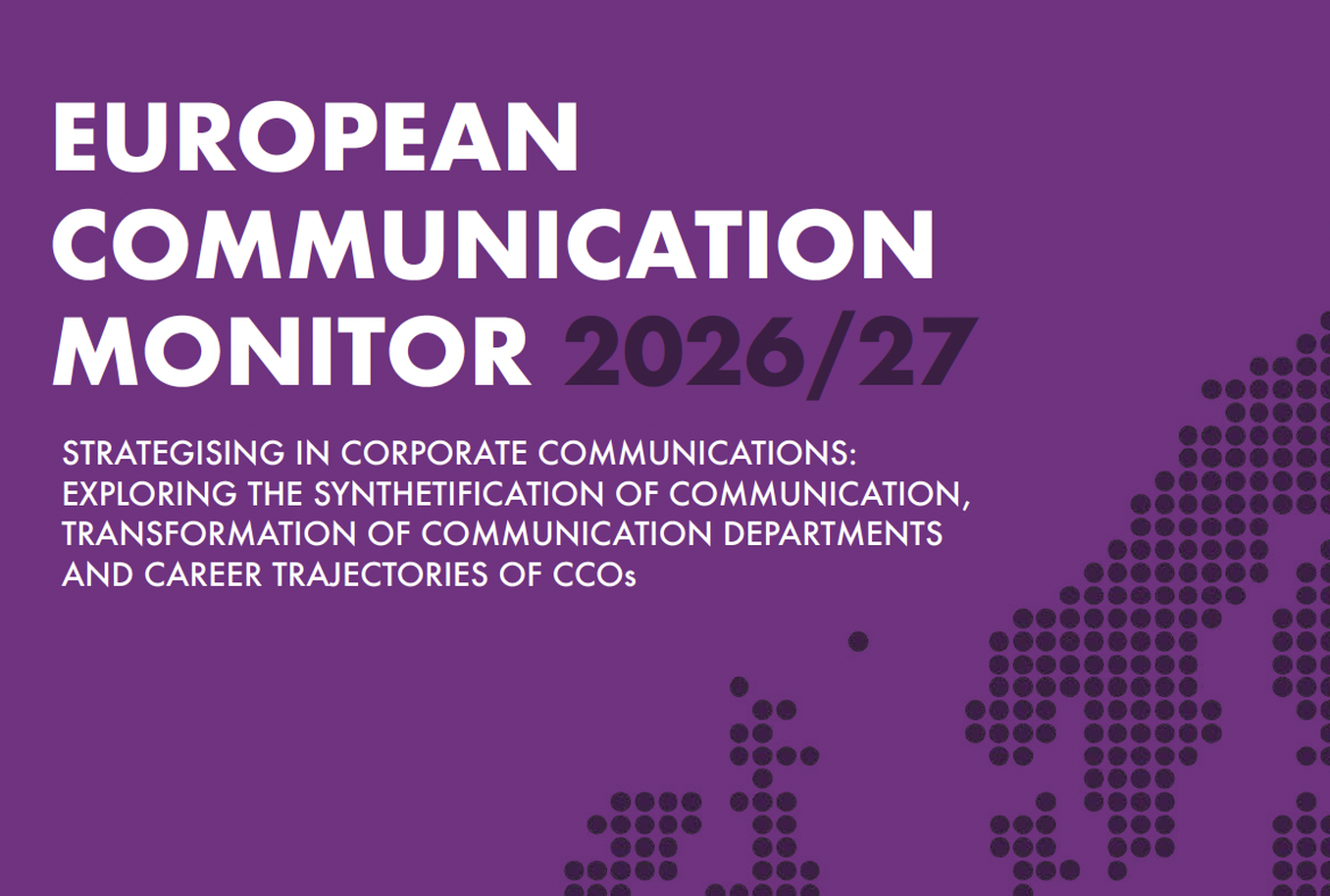
European Communication Monitor 2026/27 Report now available!
The European Communication Monitor (ECM) is the world’s longest-running and largest academic study on corporate communications and corporate affairs.
In its 2026/27 edition, the study once again applies its innovative research design: interviewing a random sample of 30 chief communication officers (CCOs) from the 300 largest companies headquartered in Europe, among them Ahold Delhaize, Air Liquide, Aviva, CaixaBank, Crédit Agricole, Generali, KONE, National Grid, REWE Group, Safran, Siemens Energy, Telefónica, Vodafone and Zurich Insurance.
The experiences and perspectives of these top leaders provide unique insights into three pressing topics in strategic communication, all examined through the lens of strategising:
- Synthetification of public communication
- Transformation of communication departments
- Career paths of CCOs
The study is conducted by six renowned professors from universities across Europe and supported by leading industry associations. It meets the highest standards of scientific independence and rigour.
The full ECM 2026/27 Report (PDF) is available free of charge at www.communicationmonitor.eu
Strategising in corporate communications
Businesses operate in environments that are increasingly complex, turbulent and unpredictable. This puts pressure on corporate leaders, in general management as well as in corporate communications. Management research shows that the capability to strategise is a critical basis of sustained competitive advantage. But strategising is more than having a plan: it is an activity through which leaders construct, negotiate and enact strategy in daily practice.
The ECM 2026/27 is the first study to apply this lens systematically to corporate communications. It shifts attention from strategy as a document to strategy as something people actually do, through shared practices, concrete episodes of action and the people involved. Across all three topics, the study reveals a pattern that unsettles the profession’s self-image: strategising rarely follows the deliberate, top-down mode CCOs claim for themselves. Direction is set, but strategies take shape through experimentation, negotiation and adaptation, frequently in response to conditions the communication leaders do not control.
Three topics on three levels of analysis
The ECM 2026/27 addresses three topics that will shape the future of corporate communications and corporate affairs, each located on a different level of analysis.
1) Synthetification of public communication (macro level)
Generative AI, recommendation algorithms and automated agents are reshaping how information is produced, distributed and encountered. The study introduces synthetification as an integrative framework for this shift: the arena itself has changed, not just the toolbox.
“There is an enormous change. For me it is a tectonic change … There is a reconfiguration, a very deep change of the communication ecosystem,” says one of the interviewed CCOs.
Eight out of ten CCOs consider synthetification a strategic concern for their company, yet most interpret it through an instrumental lens of productivity and efficiency. Responses concentrate on what feels directly actionable, such as Generative Engine Optimisation (GEO), AI councils and governance rules, and, notably, on a renaissance of owned platforms, press relations and direct stakeholder contacts as credibility anchors. The study recommends five priorities for communicators:
- Broadening the perspective from AI use to the reconfigured communicative context
- Developing nuanced strategic thinking about an ecosystem dominated by machines
- Investing in authenticity, information quality, human expertise and relationships to safeguard trust
- Acting responsibly given corporations’ power to shape the public sphere
- Reflecting critically on the future relevance and ethical accountability of professional communications
2) Transformation of communication departments (meso level)
Two-thirds of the interviewed CCOs currently have change or transformation on their agenda, and most efforts target the operating model: roles and skills, structures, processes, technology and team culture. The most striking finding contradicts a prevailing industry narrative: it is not AI that drives the deepest change, but internal pressure to do more with less. Technological innovation tends to produce incremental adjustments, whereas efficiency demands and business shifts trigger genuine transformation.
At the same time, CCOs largely portray change as imposed on them, while claiming agency over their response.
“It is a terrain that is in permanent change, because in the end you live off the management of an external reality that you do not direct,” says one CCO.
Four aspects deserve attention:
- Proactivity in taking ownership before others recognise the need
- Alignment with business performance rather than professional narratives
- Comprehensiveness across all elements of the business model
- Capabilities for sensing, seizing and reconfiguring in deliberate, emergent or hybrid modes
3) Career paths of CCOs (micro level)
Unlike other professions, communications has no pre-drawn route to the executive suite. The study shows that boundary-crossing peaks in mid-career and recedes once the top role is reached. More surprisingly, the higher communication professionals climb, the more career order evaporates: spontaneous offers, restructurings and sudden vacancies dominate, while formal succession recedes. CCOs nevertheless narrate coherent and agentic trajectories, retrospectively reframing chance as choice.
“A CCO career is built on one-third luck, one-third hard work and one-third talent,” as one interviewee puts it.
Reaching the apex requires a profound identity shift from communications expert to business leader, and career-defining breakthroughs emerge from deep relational trust with CEOs and boards, typically forged in crises and stretch roles. Four factors are at the core:
- Serendipity
- Identity
- Trust
- Storytelling
A unique study with robust scientific design
Unlike industry surveys, the ECM is based on established theories, pretests and an elite sample of CCOs from the Top 300 companies in Europe. It applies a rigorous mix of qualitative interviews and quantitative surveys, conducted by six independent professors: Ansgar Zerfass (Germany), Alexander Buhmann (Norway), Aurélie Laborde (France), Ralph Tench (UK), Cristina Navarro (Spain) and Stefania Romenti (Italy).

The ECM is in its 20th year and is organised by EUPRERA and supported by leading networks of communication leaders including the Academic Society for Management & Communication, CECOMS (Italy), #NORA, The Nordic Alliance for Communication & Management, Corporate Excellence (Spain) and Entreprises et Médias (France).
Looking ahead
The ECM 2026/27 provides one-of-a-kind insights into how Europe’s communication leaders strategise in environments they only partly control. By exploring challenges faced at the level of public communication, communication departments and individual careers, the study shows pathways to strengthen communication as a driver of corporate and societal transformation.
About the European Communication Monitor
The European Communication Monitor (ECM), started in 2007, has over the past decades grown into the largest and longest running collaborative research project in the field of corporate communications globally. It is organised by a group of professors who are world-renowned researchers in the field. Past study reports have been downloaded more than 230,000 times. Peer-reviewed journal articles based on the study have received multiple awards around the world. A book highlighting the pillars of communication excellence derived from the findings is available in several languages including English, Chinese and Spanish.
In 2024, the study design was refined to focus on corporate communications exclusively and interview an elite sample of communication leaders representing the 300 top companies across Europe. The quality and neutrality of the study are guaranteed by a strong team of partners. A research team of six professors from the United Kingdom, Germany, France, Italy, Spain and the Nordics covers different business cultures and languages of key markets.
The non-commercial study is organised within the framework of the European Public Relations Education and Research Association (EUPRERA). It is supported by five initiatives representing communication directors of major businesses across Europe: the Academic Society for Management & Communication (Germany, Switzerland, Austria), CECOMS (Italy), #NORA (Norway, Finland, Sweden, Denmark), Corporate Excellence (Spain) and Entreprises et Médias (France).
About the survey organiser
The European Public Relations Education and Research Association (EUPRERA) is an autonomous organisation with nearly 500 members from 40 countries. Its mission is to enhance and promote innovation in the knowledge, research, education and practice of public relations and strategic communication. Through its membership of universities and other research associations and bodies, EUPRERA is a global leader on high-profile transnational research projects and networks. More than 200,000 scholars and practitioners can potentially be reached through its extended communication channels and partnership arrangements.