 info@euprera.org
 Facebook
 YouTube
 LinkedIn

2026 Best Papers and Best Reviewer Award Winners
On the occasion of its annual Congress, the European Public Relations Education and Research Association (EUPRERA) has awarded authors for their excellent research and the best reviewer for their contribution. This year, the annual Congress was hosted by Lund University in Lund, Sweden.
EUPRERA Best Paper Awards 2026
The Awards were given to the authors of the three papers with the highest rankings in a blind peer-review process performed by experienced reviewers from the EUPRERA community, under the guidance of the Heads of the Scientific Committee, Martina Topić-Rutherford and Sarah Marschlich. The winning papers were selected for their conceptual contribution, methodological quality, and relevance to contemporary challenges in the field.
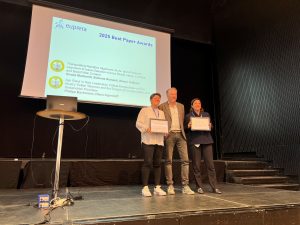
The three winning papers are:
1st place – Enacting Sustainability Through Communication: Transformative Roles, Ethical Agency, and Organisational Constraints in Paradoxical Times
by Francisca Weder, Chiara Valentini, Flora Hung-Baesecke

This paper is awarded first place for its ambitious and timely contribution to sustainability and strategic communication scholarship. It moves beyond viewing sustainability communication primarily as reporting or messaging and instead conceptualises communication as a practice through which sustainability is interpreted, negotiated, and enacted within organisations. Drawing on 77 interviews across Finland, Austria, and Australia, the study demonstrates how organisational structures, leadership, and regulatory environments shape professional agency. Particularly valuable is its identification of change-agent roles centred on networking, coaching, storytelling, and challenging established assumptions. Its conceptual ambition, comparative depth, and relevance to contemporary organisational challenges make it the strongest paper in this year’s competition.
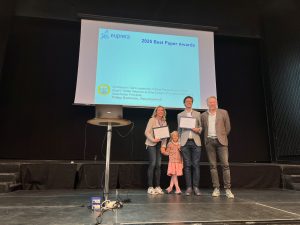
2nd place – Not Any Stance, but My Stance! Why People Support Corporate Social Advocacy Only When It Aligns With Their Own Position
by Thomas Koch, Sandra Mechler, Nora Denner

This paper is awarded second place for its conceptual clarity, methodological strength, and important challenge to assumptions about corporate social advocacy. Using a representative survey of 1,135 respondents, the study demonstrates that expectations of corporate advocacy are strongly shaped by people’s own positions on controversial issues. Rather than broadly expecting companies to participate in sociopolitical debate, publics appear more supportive when corporate positions align with their existing views. The study also shows that behavioural responses are asymmetrical, with avoidance and punishment more common than reward. These findings meaningfully complicate existing scholarship and offer important implications for organisations communicating in increasingly polarised environments.
3rd place – Facing the Numbers: An Eye-Tracking Analysis of the Effects of C-Suite Visuals and Text Valence in Annual Reports
by Laura Hackl, Andreas Enzminger

This paper is awarded third place for its methodological innovation and original contribution to investor relations, visual communication, and impression-management research. Combining eye-tracking with survey measures, the study examines how audiences process leadership imagery alongside positive and negative textual information in annual reports. The findings show that executive images attract attention and can strengthen perceptions when accompanying information is positive, but cannot compensate for negative information. By demonstrating that textual valence can override visual cues, the study adds useful nuance to assumptions about visual impression management while also showing the value of eye-tracking for strategic communication research.
EUPRERA Best Reviewer Award 2026
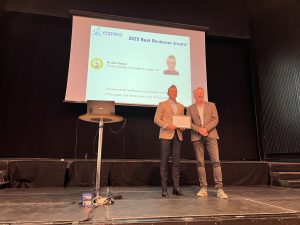
The Best Reviewer Award recognises exceptional dedication, quality, and collegiality in the peer-review process, key values that uphold the academic standards of the EUPRERA Congress. This year’s winner is:
Anastasios Theofilou
Bournemouth University, UK

This year’s Best Reviewer Award recognises Anastasios Theofilou, whose contribution to the review process combines scholarly rigour, reliability, generosity, and genuine collegiality. This reviewer consistently accepts invitations to review and can always be relied upon to support the process, responding to requests with characteristic warmth and often with the reassuring words, “Of course, you can always count on me.” The reviews themselves are consistently detailed, thoughtful, constructive, and developmental, offering authors substantive feedback that helps them strengthen their work rather than simply assessing it. This commitment is reflected in consistently excellent evaluations, including five-star ratings and highly positive feedback on the quality and usefulness of the reviews. What particularly distinguishes this reviewer is the combination of intellectual care and personal generosity brought to an increasingly demanding form of academic service: responsive, friendly, dependable, and consistently willing to contribute while maintaining a very high standard of scholarly engagement.


 This paper provides a state-of-the-art overview of an important area that is less studied, investor relations and financial communication. It uses a bibliometric approach that draws on big data analysis and opportunities for different forms of analysis that technology/AI allows. Through the historical review, it nicely positions itself in relation to previous literature, highlighting similarities, differences, and relationships. It is a well-designed and methodologically sound interdisciplinary paper that significantly contributes to the under-developed study of investor relations and financial communication as part of strategic communication.


 This paper significantly contributes to the realm of public affairs by providing valuable insights into how politicians and lobbyists in Norway use the concept of public interest to advocate for or against energy and environmental issues. The paper is well constructed, rigorous and well-argued. It offers a comprehensive, relevant, and coherent theoretical framework that thoroughly examines the utilization of “topos” in the communicative interactions of these influential social actors. The theoretical framework is highly valuable in that it can be used to analyze a diverse set of advocacy initiatives beyond the ones in focus in this study. Overall, this study constitutes a significant advancement in the understanding of lobbyism and rhetoric within the political sphere and offers a theory-driven tool to dissect the quality of argumentations of those in power and the role of communication in affecting democratic processes.
 This paper explores the frequently used, yet ambiguously defined concept of VUCA, aiming to provide a conceptual and empirical analysis that sheds light on its impact on strategic communication and outlines effective responses to its challenges. The study is backed by qualitative data gathered in Austria. A commendable aspect of this research is the authors’ intention to enhance our comprehension of VUCA while contributing to the theoretical understanding of current public relations in both internal and external environments. To aid professionals in navigating complex and volatile situations, the paper introduces a valuable tool called the VUCA RADAR. Overall, the study stands out as an intriguing, innovative, pertinent, and ambitious contribution to the field.
 This paper proposes an integrative approach for future research in public relations and communication management. The methodological approach integrates insights from research developments in society, management, and technology and integrates insights from professionals. There is a nice dialectical engagement between theory and practice-based experiences which positions this work as one highly commented for its practical implications and contribution in expanding our knowledge for conducting formative research. Overall, the paper suggests an innovative integrative methodological perspective, that can become an important practical toolkit for professionals and their research efforts in identifying key trends.
 Dr. Johnson’s review stands at an exceptional level of quality. Her feedback is thorough, comprising in-depth and comprehensive comments, along with practical suggestions that effectively aid authors in enhancing their papers. Notably, her constructive and encouraging remarks prompt authors to introspect on their arguments and research decisions. Moreover, the review exhibits attentive feedback and a profound respect for diverse academic cultural traditions and perspectives, making it truly commendable.
 “Navigating Moral Minefields in a VUCA-World: The Contribution of Moral Foundations Theory to Research on Issues Management, Risk and Crisis Communication” by Timo Lenk
  “Polarized Stakeholders and Crisis Communication” by Michael Etter
 “Prospects and Risks of Digitalization in Public Relations Research: Mapping Recurrent Narratives of a Debate in Fragmentation (2010-2021) ” by Jannik Kretschmer and Peter Winkler
 “Knowing Thy Enemy and Fighting the Good Fight: A Framework for Organizational Preparation for and Response to AI-driven Disinformation Campaigns” by Elise Maria Karinshak and Yan Jin
 Vibeke Thøis Madsen for her chapter “Communicative Leadership on Internal Social Media: a Way to Employee Engagement?”, published in the volume Joy. Using Strategic Communication to Improve Well-being and Organizational Success.
 Maria Isaksson from BI Norwegian Business School, Norway, who has contributed to careful, thorough and useful reviews.

 “Small But Mighty. Communication Strategies Of Dutch Local Energy Initiatives” by Petrus ter Halle, Pascal de Vries, Liesbeth Hermans.
 “The Democratic Success of Twitter as a Lobbying tool” by Øyvind Ihlen, Ketil Raknes, Anders O. Larson.
 “Building Community Resilience: Strategic Communication in Disaster Management”, by Gayadini Imesha Dharmasena Madho Kandage, Margalit Toledano, Kay Weaver.
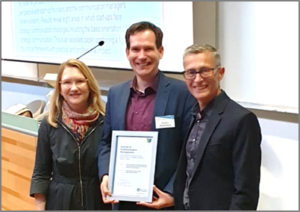 “Happy or End: The Role of Strategic Communication in Start-ups”, by Markus Wiesenberg, Alexander Hagen Godulla, Katharina Tengler, Inga-Marit Noelle, Julia Kloss, Natalie Klein and David Eeckhout.
 EUPRERA Best Reviewer Award recognizes the work done by the reviewer because it is an essential contribution to the quality and the success of the annual congress. The scientific committee identified as this year’s winner:
 ““Big Ideas“ Emerging From a Microscopic Perspective. The Why and How of Conversation Analytic Thinking for Strategic Communication” by Christian Schwägerl.
 “The Conceptual Heritage of Public Relations: Using Public Memory to Explore Constraints and Liberation” by W. Timothy Coombs and Sherry Holladay.
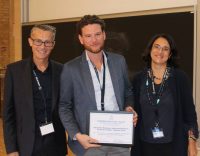 “Controlling Conversations: The Effects of Moderation Strategies in Online Stakeholder Dialogues”, by Alexander Buhmann, Kateryna Maltseva, Christian Fieseler, Matthes Fleck.
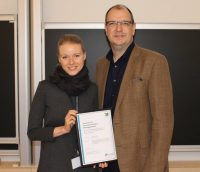 “Communicating the Corporate Strategy: An International Benchmark Study in the United Kingdom, the United States and Germany”, by Karolin Köhler, Ansgar Zerfass.
 EUPRERA Best Reviewer Award recognizes the work done by the reviewer because it is an essential contribution to the quality and the success of the annual congress. The scientific committee identified as this year’s winner: