info@euprera.org
 Facebook
 YouTube
 LinkedIn

European Communication Monitor 2025/26 Report now available!
The European Communication Monitor (ECM) is the world’s longest-running and largest academic study on corporate communications.
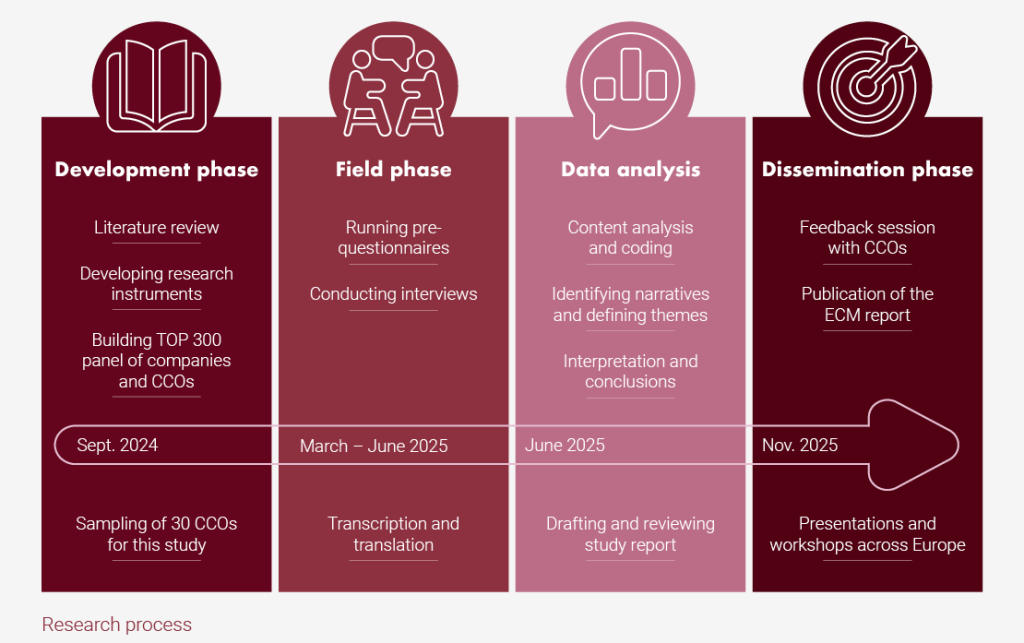
In its 2025/26 edition, the study once again applies its innovative research design: interviewing a random sample of 30 chief communication officers (CCOs) from the 300 largest companies headquartered in Europe – among them Allianz, Bayer, DHL, Carrefour, Heineken, Ferrero, Generali, Henkel, L’Oréal, Novo Nordisk, BBVA, Orange, and WPP.
The experiences and perspectives of these top leaders provide unique insights into three pressing challenges in strategic communication, all examined through the lens of intergenerational diversity:
-
Values-based corporate positioning
-
Strategic talent management in communication departments
-
Coaching as a leadership imperative for CCOs
The study is conducted by six renowned professors from universities across Europe and supported by leading industry associations. It meets the highest standards of scientific independence and rigour.
The full ECM 2025/26 Report (PDF, 44 pp.) is available free of charge at www.communicationmonitor.eu
Communication in times of generational diversity
Business and society are being reshaped by demographic change, digitalisation, and new social expectations. Five different generations now coexist in many workplaces, each with its own values, working styles, and expectations. This diversity creates both opportunities and challenges for business and communication leaders.
The European Communication Monitor 2025/26 explores how CCOs respond to these dynamics, offering practical guidance for navigating today’s volatile environment. The study highlights that corporate communications must go beyond traditional message control and instead embrace intergenerational diversity as a resource. Leaders are encouraged to co-create strategies with employees and stakeholders across age groups, fostering alignment and trust in increasingly fragmented environments.
Three areas where CCOs face intergenerational challenges
The ECM 2025/26 study identifies three areas that will shape the future of strategic communication and require specific attention. These areas produce considerable intergenerational challenges which CCOs have to navigate. The topics investigated in each annual edition of the ECM are rooted in interdisciplinary debates, scientific research, and the results of rigorous pretests.
1) Positioning organisations through values
“Values are no longer static statements in mission documents. We found CCOs increasingly treat values as ‘living constructs’ which are adaptable, negotiated, and continuously reinterpreted across contexts” says Professor Stefania Romeni from IULM University, Milan. Values-based positioning is becoming a critical tool for maintaining trust and cohesion across generational divides. The study recommends five priorities for CCOs:
- Ensuring performativity of values
- Aligning internal and external narratives
- Designing flexible messaging frameworks
- Integrating listening tools
- Leveraging generational diversity as a strategic resource
2) Managing and retaining top talent
“Attracting and retaining ‘A-communicators’ – those who are high-potential communication professionals – is a growing challenge, especially with millennials and Generation Z,” says Professor Ángeles Moreno, University Rey Juan Carlos, Madrid. “Effective talent strategies go beyond recruitment to building inclusive cultures that reflect corporate values and create visible business impact.” The report outlines how CCOs emphasise development programmes, cross-functional experiences, and personalised career paths to meet diverse generational expectations. The study recommends five aspects to consider:
- Combine people-centric and position-based approaches to align talent and function with business goals
- Promote internal talent as a competitive advantage by offering opportunities and visibility to top performers
- Encourage hybrid profiles that blend creativity and business acumen, and foster adaptable leadership across generations
- Tailor Employer Value Propositions (EVPs) and career paths to meet diverse generational expectations
- Reinforce communication as a strategic, cross-functional career path linked to measurable results
3) Coaching as a strategic imperative
“Coaching is no longer seen as a tool for performance enhancement alone, but as a central leadership philosophy.” says Professor Ralph Tench, Leeds Beckett University. “Our study shows how CCOs act as strategic coaches – for their teams, peers, and even CEOs – to nurture leadership capacity and organisational resilience.” Inclusive, situational coaching styles that reject generational stereotypes prove most effective. Key success factors discussed in the report include:
- Treating coaching as a long-term strategy to build future leadership capacity
- Adapting coaching styles to individual needs and contexts, moving beyond one-size-fits-all approaches
- Using peer and reverse coaching to foster cross-generational learning and innovation
- Leveraging coaching to reinforce organisational values and align leadership behaviours
- Demonstrating the value of coaching with robust evaluation and impact metrics
A unique study with robust scientific design
Unlike industry surveys, the ECM is based on an elite sample of CCOs from the Top 300 companies in Europe. It applies a rigorous mix of qualitative interviews and quantitative surveys, conducted by six independent professors: Ralph Tench (UK), Ángeles Moreno (Spain), Stefania Romeni (Italy), Alexander Buhmann (Norway), Aurélie Laborde (France), and Ansgar Zerfass (Germany).

The ECM is in its 19th year and is organised by EUPRERA and supported by leading networks of communication leaders including the Academic Society for Management & Communication, CECOMS (Italy), #NORA – The Nordic Alliance for Communication & Management, Dircom (Spain), Entreprises et Médias (France), with Fink & Fuchs designing the report and website.
Looking ahead
The ECM 2025/26 provides unique insights into how Europe’s communication leaders address intergenerational challenges in positioning, talent, and coaching. By exploring challenges faced at the organisational, departmental, and individual levels, the study shows pathways to strengthen communication as a driver of corporate and societal transformation.
About the European Communication Monitor
The European Communication Monitor (ECM), launched in 2007, has over the past decades grown into the largest and longest-running collaborative research project in the field of corporate communications globally. It is organised by a group of professors who are world-renowned researchers in the discipline. Past study reports have been downloaded more than 230,000 times, and peer-reviewed journal articles based on the study have received multiple awards worldwide. A book highlighting the pillars of communication excellence derived from the findings is available in several languages, including English, Chinese, and Spanish.
In 2024, the ECM entered a new phase. The study design has been refined to focus exclusively on corporate communications and to interview an elite sample of communication leaders representing the 300 top companies across Europe. The quality and neutrality of the study are guaranteed by a strong team of partners. A research team of six professors from the United Kingdom, Germany, France, Italy, Spain, and the Nordic countries covers different business cultures and languages across key markets.
The non-commercial study is organised within the framework of the European Public Relations Education and Research Association (EUPRERA). It is supported by five initiatives representing communication directors of major businesses across Europe: the Academic Society for Management & Communication (Germany, Switzerland, Austria), CECOMS (Italy), #NORA (Norway, Finland, Sweden, Denmark), Dircom (Spain), and Entreprises & Médias (France).
About the survey organiser
The European Public Relations Education and Research Association (EUPRERA) is an autonomous organisation with nearly 500 members from 40 countries. Its mission is to enhance and promote innovation in the knowledge, research, education and practice of public relations and strategic communication. Through its membership of universities and other research associations and bodies, EUPRERA is a global leader on high-profile transnational research projects and networks. More than 200,000 scholars and practitioners can potentially be reached through its extended communication channels and partnership arrangements.