info@euprera.org
 Facebook
 YouTube
 LinkedIn

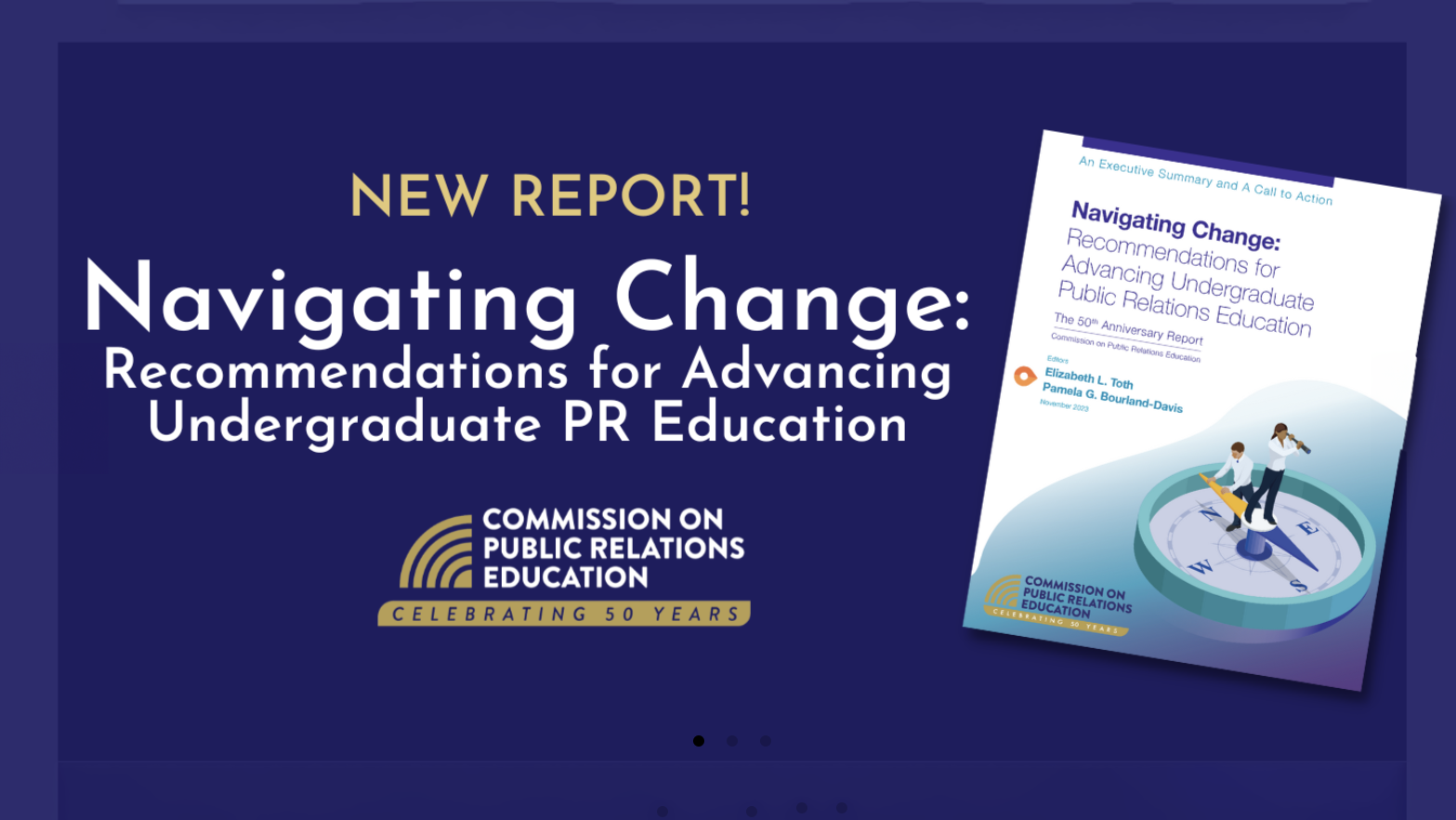
New report: Recommendations for Undergraduate Public Relations Education
The newest Commission on Public Relations Education (CPRE)’s 2023 Signature Report, Navigating Change: Recommendations for Advancing Undergraduate Public Relations Education, is now available!
To succeed in today’s public relations workplace, graduating public relations students should be critical strategic thinkers, have a
solid grounding in ethics, writing, and communication, complete an internship, and understand data analysis, DEI as an ethical social responsibility, and their role in driving social change.
Those are among the recommendations in the Commission on Public Relations Education (CPRE)’s 2023 Signature Report,
Navigating Change: Recommendations for Advancing Undergraduate Public Relations Education.
The CPRE report’s recommendations highlight seven areas that practitioners and educators identified as critical to pre-professional preparation in the post-pandemic environment.
Key recommendations include the following:
- The Future of the Public Relations Workplace. Educators and practitioners should work together to develop experiential learning opportunities for students. Educators should include case studies and other course content on the ethical challenges of contemporary practice. Employers must adapt their onboarding practices for new hires to better
represent a new workplace. - Essential Knowledge, Skills, and Abilities and the Six-Course Standard. Given that ethics is the top knowledge area, CPRE’s recommended sixth course in public relations ethics must be required in public relations curricula. It joins public relations courses in principles, research, writing, campaigns/cases, and internships.
- Critical Strategic Thinking. Public relations sequences must include critical strategic thinking, ideally using the DASA model (Detecting, Analyzing, Strategizing, Acting) and with real-world case studies to understand critical strategy.
- Data Insights and Strategy. Educators should integrate KSAs related to data analytics and AI into academic programs and build a solid foundation in quantitative and qualitative research for students. Educators also should teach students to align data analysis with measurable organizational outcomes and public relations objectives rather than low-level outputs.
- Ethics. Survey results indicated that our newest professionals are not adequately prepared to address public relations’ ethical challenges and lack a personal code of ethics. Ethics should be a required course and educators should continue to incorporate ethics into all courses across the curriculum.
- Diversity, Equity, and Inclusion (DEI). Educators should understand DEI as an ethical social responsibility to be embedded in the curriculum, take a comprehensive approach to DEI, create public relations DEI course materials, and prepare for pushback.
- PR as a Driver of Social Change. Educators must be courageous in addressing challenging issues such as gender identity, sexuality, racism, ableism, and poverty. They should ensure that their students understand their role in driving social change and consider how social change content can be integrated with skills-based and technical content.
The report represents over a year’s involvement of the 65 CPRE board members as they participated in brainstorming sessions, crowdsourcing surveys, focus groups, and an omnibus quantitative survey of more than 460 public relations practitioners and educators. Seven teams of educators and practitioners contributed their expertise and content.










 This paper significantly contributes to the realm of public affairs by providing valuable insights into how politicians and lobbyists in Norway use the concept of public interest to advocate for or against energy and environmental issues. The paper is well constructed, rigorous and well-argued. It offers a comprehensive, relevant, and coherent theoretical framework that thoroughly examines the utilization of “topos” in the communicative interactions of these influential social actors. The theoretical framework is highly valuable in that it can be used to analyze a diverse set of advocacy initiatives beyond the ones in focus in this study. Overall, this study constitutes a significant advancement in the understanding of lobbyism and rhetoric within the political sphere and offers a theory-driven tool to dissect the quality of argumentations of those in power and the role of communication in affecting democratic processes.
 This paper explores the frequently used, yet ambiguously defined concept of VUCA, aiming to provide a conceptual and empirical analysis that sheds light on its impact on strategic communication and outlines effective responses to its challenges. The study is backed by qualitative data gathered in Austria. A commendable aspect of this research is the authors’ intention to enhance our comprehension of VUCA while contributing to the theoretical understanding of current public relations in both internal and external environments. To aid professionals in navigating complex and volatile situations, the paper introduces a valuable tool called the VUCA RADAR. Overall, the study stands out as an intriguing, innovative, pertinent, and ambitious contribution to the field.
 This paper proposes an integrative approach for future research in public relations and communication management. The methodological approach integrates insights from research developments in society, management, and technology and integrates insights from professionals. There is a nice dialectical engagement between theory and practice-based experiences which positions this work as one highly commented for its practical implications and contribution in expanding our knowledge for conducting formative research. Overall, the paper suggests an innovative integrative methodological perspective, that can become an important practical toolkit for professionals and their research efforts in identifying key trends.
 Dr. Johnson’s review stands at an exceptional level of quality. Her feedback is thorough, comprising in-depth and comprehensive comments, along with practical suggestions that effectively aid authors in enhancing their papers. Notably, her constructive and encouraging remarks prompt authors to introspect on their arguments and research decisions. Moreover, the review exhibits attentive feedback and a profound respect for diverse academic cultural traditions and perspectives, making it truly commendable.