info@euprera.org
 Facebook
 YouTube
 LinkedIn

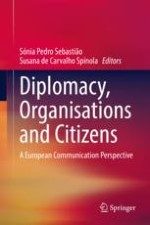
New Book: Diplomacy, Organisations and Citizens
Diplomacy, Organization and Citizens
edited By Sónia Pedro Sebastião and Susana de Carvalho Spínola
published by Springer International Publishing
This book uses an innovative interdisciplinary approach to explain how communication is a necessary condition for diplomacy in a digital and relationship-driven world. Divided into three parts, it highlights the importance of communication strategies and processes in contemporary society and in current global socio-political events in general, particularly within the field of diplomacy.
The first part discusses the main theoretical debates that shaped the central concepts of the project, while the second part of the book presents further practical approaches and examples of diplomatic practice. Lastly, the third part focuses on pedagogical and methodological approaches, which can be useful in diplomacy and communication classes and for the implementation of a European curriculum.
This interdisciplinary book will appeal to students, researchers, policy-makers, and practitioners from various disciplines, including international relations, political science, business, and communication.
We invite colleagues who are interested in the topic of diplomacy and communication to look at our support material from the MARPE Network.

 “In the 21st Century, our universal community of fate is characterized by grand challenges, external shocks and global fragilities in crisis context, such as economic volatility and societal upheaval. These destabilizing turbulences reveal a paradigmatic shift in the global system with its dysfunctional multilateral organizations towards an era of fragmented and disintegrated international (dis-)order”. This is the starting point proposed by Professor Wilfried Bolweski for this talk. Advancing that “international society is in demand of content-sensitive orientation knowledge to reassess, adjust and accommodate diplomacy’s essentials (human factor interdependency and interactions: diplomacy for good) to new expectations of the public sphere”. And “confronted with social and environmental demands international business enterprises seen as “private public entities” are requested to get involved in issues of public concern by providing public goods and co-creating more just and peaceful co-existing societies. International diplomacy provides the tools for corporate conflict management. In tackling grand challenges, corporations are becoming diplomatic co-actors in the trade of diplomacy and acquiring access to the diplomatic arena. (…) Today’s societal purpose of international management is not merely business, and business is not an end in itself, but its social impact should also serve a common good purpose. (…) In tackling grand challenges, corporations are becoming diplomatic co-actors in the trade of diplomacy and acquiring access to the diplomatic arena.”